

WINSENT Large-N Experiment
A large-scale measurement experiment on ground movements at the wind energy test site
Wind turbines are a cornerstone of the energy transition. Modern turbines reach tower heights of up to 170 meters; their rotors, weighing several tons, cover areas of several thousand square meters. During operation, considerable dynamic forces are generated, which are transferred to the ground via the foundation. There, they cause wave-like ground movements which, depending on the geological conditions, can spread over several kilometers.
These vibrations are well below the threshold of human perception. However, highly sensitive instruments such as seismometers can detect them precisely. Even the smallest ground movements can be relevant for particularly sensitive research infrastructures – for example, in the context of the planned Einstein Telescope. This future large-scale European research facility is designed to measure gravitational waves – tiny distortions in space-time with amplitudes smaller than the size of atomic nuclei. In order to achieve the extreme measurement accuracy required for this, underground tunnel systems around ten kilometers long are planned at a depth of approximately 200 meters. The aim is to create a measurement environment that is as vibration-free as possible.
Against this backdrop, the WINSENT Large-N project is systematically investigating the seismic emissions generated by wind turbines.
The WINSENT test site as a unique research infrastructure
The experiment was conducted at the WINSENT wind energy test site in the Swabian Alb, which is operated by the Center for Solar Energy and Hydrogen Research Baden-Württemberg (ZSW). The site has two wind turbines (RWT) specially designed for research purposes, which enable scientific experiments to be carried out under controlled conditions.
The research wind turbines are comprehensively instrumented:
Strain gauges and accelerometers record the structural and dynamic loads in the towers.
Sole pressure sensors and extensometers measure stresses and deformations in the foundation area.
This exceptionally dense sensor network allows not only the response of the structures themselves to be examined in detail, but also their interaction with the ground.
Over 560 seismometers: The Large-N Experiment
In order to systematically record the ground movements emitted by the RWT, geophysicists from the Karlsruhe Institute of Technology (KIT), together with partners from Ludwig Maximilian University in Munich, the University of Liège, and the Royal Observatory of the Netherlands, set up an exceptionally extensive seismological measurement experiment.
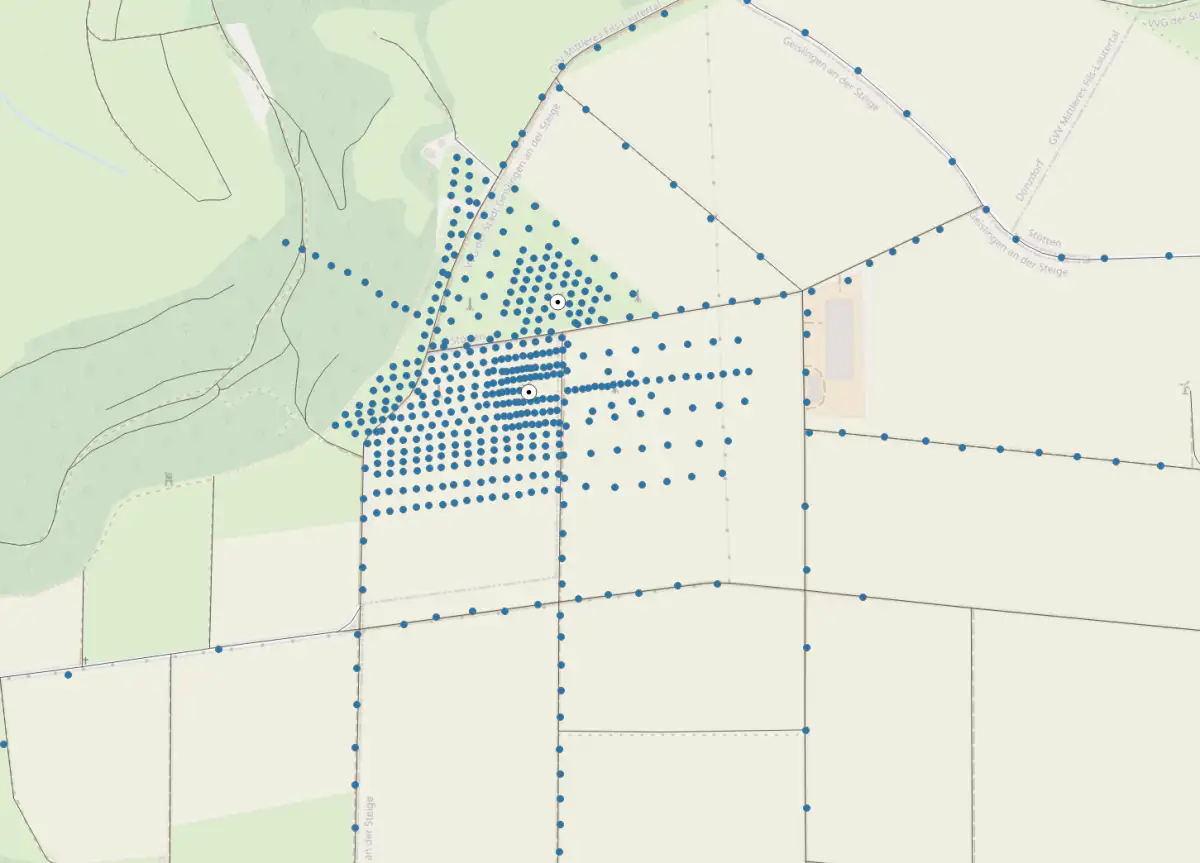
A total of over 560 seismometers were distributed in a ring and grid pattern around the two wind turbines—in addition to the three permanently measuring seismometers in 5-meter-deep boreholes at the test site. Seismological experiments with such a large number of measuring devices are referred to as large-N measurements—hence the name “WINSENT Large-N.”
During the measurement campaign from early December 2024 to mid-January 2025, the sensors continuously recorded ground movements at a sampling rate of 200 measurements per second. In addition, seismometers and high-precision rotation sensors were installed directly in the foundations of the wind turbines. This made it possible for the first time to directly measure not only the wave field radiated underground, but also the movement of the foundations themselves.
From measurement to model validation
The enormous amount of data will now be analyzed in detail over the coming months. The aim is to understand the entire transmission chain: from the movement of the tower via the foundations, which are built directly on rock, to the propagation of seismic waves underground.
For the first time, this will enable the movement of the foundations and the spatial-temporal wave propagation to be visualized in high resolution. The results will make it possible to validate numerical simulation models that calculate the emitted seismic wave field and its propagation underground.
Validated models are a crucial component in the site assessment for the Einstein Telescope. They enable potential interference from wind turbines at planned sites to be identified at an early stage and mitigation strategies to be developed where necessary.
Funding within the ET-Geo Project
The WINSENT Large-N experiment is funded by the German Federal Ministry of Research, Technology, and Space as part of the preliminary work for the Einstein Telescope. It is part of the ET-Geo project, which is laying the geoscientific foundations for the possible realization of this major European research infrastructure.
WINSENT Large-N thus creates a globally unique database for quantitatively recording the interactions between wind turbines and highly sensitive basic research—thereby providing a scientifically sound basis for reconciling the energy transition with cutting-edge international research.